Showing posts with label Predictive Models. Show all posts

Wednesday, January 8, 2014

Zementis and Teradata Announce In-database Scoring for Big Data


As a result of its partnership with Teradata, Zementis is excited to announce the availability of the Universal PMML Plug-in (UPPI) for Teradata analytic platforms. It does not get easier than this! Simply deploy your predictive models built in R, IBM SPSS, SAS EM, ... and score your big data, directly in-database, where it resides.

The Zementis Universal PMML Plug-in (UPPI) enables the execution of standards-based predictive analytics directly within the Teradata Unified Data Architecture™. Users can now easily deploy predictive models built in R, IBM SPSS, SAS EM and other popular analytic tools on Aster and/or Teradata to achieve scale. The bridge between these systems is PMML, the Predictive Model Markup Language standard. It allows for models to be instantly moved from the scientist's desktop to the database where they will be executed.


As described by Teradata's Chris Twogood, VP for Product and Services Marketing, "by partnering with Zementis, we are able to offer high performance, enterprise-level predictive analytics scoring for the major analytics tools that support PMML. With Zementis and PMML, we are eliminating the need for customers to recode predictive analytic models in order to deploy them within our database. In turn, this enables an analyst to reduce the time to insight required in most businesses today."

Available for Teradata and Teradata Aster databases, UPPI leverages the massively parallel databases as a scalable, high-performance, scoring engine that easily processes through petabyte-scale data volumes. UPPI takes full advantage of the high-performance data warehouse with its massively parallel processing capabilities for rapid execution of standards-based predictive analytics based on the PMML standard.

Models built in most commercial and open source data mining tools can now instantly be deployed in Teradata or Aster. The net result is the ability to leverage the power of standards-based predictive analytics on a massive scale, right where the data resides.

Wednesday, August 7, 2013

Data Transformations - from R to PMML - The pmmlTransformations Package

We are very excited to announce the availability of the R pmmlTransformations package. This package allows you to export data transformations together with your model from R into a PMML file, which you can then be deployed in the Zementis ADAPA or UPPI scoring engines. Real-time or big data scoring made easy with R, PMML, and Zementis.
The pmmlTransformations package provides R users with functions that greatly enhance the available data mining capabilities and PMML support by allowing transformations to be performed on the data before it is used for modeling. The pmmlTransformations package works in tandem with the pmml package so that data pre-processing can be represented together with the model in the resulting PMML code. 
In R, this process includes three steps:
  1. With the use of the pmmlTransformations package, transform the raw input data as appropriate
  2. Use transformed and raw data as inputs to the modeling function/package (hclust, nnet, glm, ...)
  3. Output the entire solution (data pre-processing + model) in PMML using the pmml package
Screen_Shot_2013-08-06_at_10.46.57_AM.png

The pmmlTransformations package is available for download in CRAN (as well as the pmml package). Give it a try!


Wednesday, July 10, 2013

PMML Workshop at KDD 2013 and UCSD Extension PMML Class

KDD 2013 PMML Workshop

Join us for the KDD PMML Workshop to be held in Chicago on August 11. Organized by the Data Mining Group (DMG), this workshop will feature invited talks and presentations of selected papers.

Zementis will be presenting two papers about PMML-support in R: Coding and representing data transformations and model through the pmmltransformations and pmml packages.


UCSD PMML Class (Coming this Fall)

UCSD Extension has teamed up with the San Diego Supercomputer Center Predictive Analytics Center of Excellence (PACE) and Zementis to offer a PMML class to the data mining community on October 24 and 25.


For more information about this great opportunity to learn the standard that is revolutionizing how predictive solutions are documented and deployed, refer to the UCSD Extension catalog.

Thursday, January 24, 2013

R PMML Support: Data Transformations


R and PMML Export 
  
R is becoming the tool of choice for many data scientists. It is no wonder that many commercial and open-source statistical tools are also embracing R.

Predictive Models

A set of robust predictive analytic techniques is but one set of tools available to data scientists in R. Another important set is the ability to export PMML for a host of predictive models. 

By using the pmml package (version 1.2.33 or higher), users can export PMML from R for:
  • Random Forest Models
  • Neural Networks
  • Clustering Models
  • Cox Regression Models
  • Linear and Logistic Regression Models
  • Support Vector Machines
  • Association Rules
  • Generalized Linear Models
  • Random Survival Forest Models

Data Transformations

And now, another R package extends this functionality by providing PMML export for data transformations. The new pmmlTransformations package has just made its way to CRAN (the Comprehensive R Archive Network). 

Want to apply a Z-scoring normalization procedure to your continuous input variables before presenting them to a neural network? No problem. Use the pmmlTransformations package in conjunction with the pmml package (version 1.2.33 or higher) to export the entire process (pre-processing + model) into a PMML file. 

To look at the package's documentation in CRAN, click HERE.

Agile Predictive Analytics Deployment

Once represented as a PMML file, a predictive solution (data transformations + model) can be readily moved into the operational environment where it can be put to work immediately. That's the promise of PMML.

Zementis offers a host of products for the agile deployment and execution of your PMML-based solutions. Our ADAPA and UPPI scoring engines are available for:
  • Hadoop: Datameer and Hadoop/Hive
  • In-database: EMC Greenplum, IBM Netezza, SAP Sybase IQ, Teradata, and Teradata Aster
  • Cloud: Amazon EC2 and IBM SmartCloud Enterprise
  • On-site: On your own servers
Real-time or Big Data requirements? Zementis has you covered.

Contact us today for more information or to schedule a presentation/demo.

Friday, October 5, 2012

Seamless Integration of Predictive Analytics and Business Rules

Operational deployment of predictive solutions includes exporting the data mining models you built in SAS, IBM SPSS, STASTISTICA, KNIME, R, ... into PMML, the Predictive Model Markup Language. Once in PMML standard, these models can be easily moved into production: on-site, in the cloud, Hadoop or in-database. Zementis offers a range of products that make this possible. These include the ADAPA Decisioning Engine and the Universal PMML Plug-in. Besides providing a predictive analytics engine, ADAPA also encapsulates a rules engine which allows for predictive models to be seamlessly integrated with business rules.


In this demo, we show a pre-qualification app that uses predictive models and rules to analyze the risk of mortgage default on loan applications. An application is accepted or referred for a variety of loan products depending on its perceived risk. ADAPA is the engine driving this application in the back-end.

Once logged in we use the ADAPA Web to download the mortgage solution files which are used throughout the demo. Predictive models expressed in PMML format are uploaded and verified in ADAPA along with rulesets expressed in tabular format. The ADAPA Web Console is used for managing predictive models, rulesets, and resource files as well as for batch-scoring. Real-time scoring is obtained via web-services or the Java API.

Finally, we show how the ADAPA Add-in for Excel is used to score data directly from within Excel. This part of the demo features the scoring of loan and tax data as well as the visualization of results via dashboards.

Thursday, August 9, 2012

Agile Deployment of Predictive Analytics on Hadoop: Faster Insights through Open Standards

This joint Datameer/Zementis presentation given at the 2012 Hadoop Summit outlines the benefits of the PMML standard as key element of data science best practices and its application in the context of distributed processing. In a live demonstration, we showcase how Datameer and the Zementis Universal PMML Plug-in (UPPI) take advantage of a highly parallel Hadoop architecture to efficiently derive predictions from very large volumes of data.

Watch it now on YouTube: 

http://www.youtube.com/watch?v=r_g99-kP_BE


Session Abstract:


While Hadoop provides an excellent platform for data aggregation and general analytics, it also can provide the right platform for advanced predictive analytics against vast amounts of data, preferably with low latency and in real-time. This drives the business need for comprehensive solutions that combine the aspects of big data with an agile integration of data mining models. Facilitating this convergence is the Predictive Model Markup Language (PMML), a vendor-independent standard to represent and exchange data mining models that is supported by all major data mining vendors and open source tools (see figure below).

PMML is an XML-based language developed by the Data Mining Group (DMG) which provides a way for applications to define statistical and data mining models and to share models between PMML compliant applications. It provides applications a vendor-independent method of defining models so that proprietary issues and incompatibilities are no longer a barrier to the exchange of models between applications. PMML allows users to develop models within one vendor's application, and use another vendors' applications to visualize, analyze, evaluate or otherwise use the models. Previously, this was very difficult, but with PMML, the exchange of models between compliant applications is now straightforward.

Wednesday, August 1, 2012

TOP 10 PMML Resources

We offer you a host of free on-line resources that allow you to expand your PMML skills. With these, you can learn how to best operationalize your predictive models, not only on your own infrastructure, but also on the cloud, in-database, or on Hadoop.

Your peers are already communicating predictive analytics with PMML. Learn how you too can benefit from it.


1) BOOK: We have recently published the 2nd edition of our PMML book. Entitled "PMML in Action", the book is available on amazon.com in paperback or in kindle format.

2) BLOGS: Another great resource for PMML related material is the predictive-analytics.info blog site. Besides highlighting the standard itself, this site also discusses the latest PMML support offered by producers and consumers.

3) VIDEOS: We have been busy producing informative webinars with our partners. You can find all our past webinars (including joint webinars with IBM SPSS and Revolution) by visiting our videos page.

4) ARTICLES: White-papers (including joint papers with KNIME and EMC), peer-reviewed articles and invited articles. Check them out! Visit the Zementis articles page.

5) TOOLS: Our tools page contains the description and link to the Transformations Generator, which allows you to graphically design your transformations and export them into PMML.

6) FORUMS: A place to ask questions and discuss model deployment. Explore and join our community forums.

7) EXAMPLES: In the DMG PMML Examples page, you not only can find typical predictive models such as neural networks and decision trees, but also association rules and random forest models.

8) PRESENTATION: Our PMML presentation at LinkedIn earlier this year to the ACM Data Mining Bay Area/SF group is available for on-demand viewing on YouTube. Presentation slides can be donwloaded HERE.

9) NEWSLETTER: The latest information on PMML and model deployment. Our Deploy! Newsletter is now on its 21st issue.

LinkedIn
10) GROUP: Last, but not least, you are welcome to join the PMML discussion group in LinkedIn now with close to 3,000 members and growing fast.


Friday, June 29, 2012

Synergies and Value Proposition between the R Statistical Package and Zementis ADAPA

The ADAPA Decision Engine provides additional value to all your predictive assets. It is complimentary to R, since it extends your modeling environment into the IT operational domain.

ADAPA® is compatible with R through PMML, the Predictive Model Markup Language, which is the de facto standard to represent predictive models. PMML allows for models to be developed in one application and deployed on another, as long as both are PMML-compliant.

Immediate benefits of using ADAPA


Once a model built in R is saved as a PMML file, it can be directly uploaded in ADAPA. With ADAPA, you can:
  • Execute your models independently of R
  • Overcome memory and speed limitations imposed by R
  • Produce scores in real-time (using Web Services or Java API), on-demand, or batch-mode
  • Tap into all the advantages of cloud computing with ADAPA on Cloud (IBM SmartCloud or Amazon EC2)
  • Execute your models directly from Excel, by using the ADAPA Add-in for Excel
  • Benefit from using other PMML-compliant model development tools such as KNIME and RapidMiner
  • Deploy your models in minutes, not months (no need for recoding models into production)
  • Manage models via Web Services or a Web console
  • Upload one or many models into ADAPA at once
  • Use rules to implement model segmentation
  • Benefit from the seamless integration of business rules and predictive models through PMML

R PMML support


R offers support for PMML through the R PMML Package available in CRAN. Zementis is a proud contributor to the PMML package which was featured on an article we wrote for The R Journal (to download article, click HERE). The PMML package allows users to export a multitude of predictive models in PMML (for details, click HERE).

We have put together a video which shows how easy it is to export PMML models from R. It uses a simple R script to build a decision tree model using rpart and exports it to PMML using the PMML package. To read posting and watch video, click HERE.

A common industry standard


PMML allows for the de-coupling of two very important modeling phases: development and operational deployment. With PMML, scientists can focus on data analysis and model building using the best of breed model development tools, whereas operational deployment and actual use of the model is made extremely easy and simple with ADAPA.

ADAPA Solutions For

For example, if a data mining scientist develops a decision tree model using R rpart package, all he/she needs to do to effectively deploy his/her model operationally is to save it as a PMML file and uploaded it in ADAPA. Once in ADAPA, the decision tree model is available for all to use, directly by business users and applications. The model may be used by a business user directly from within Excel to score customers for a marketing campaign.

By doing that, PMML allows for the model development environment to be used just for that, model development. Scoring, real-time or batch-mode from anywhere and at anytime, is handled by ADAPA.

Wednesday, January 11, 2012

PMML 4.1 is here! Mature standard for predictive analytics

The Predictive Model Markup Language (PMML) is an XML-based language developed by the Data Mining Group (DMG) which provides a way for applications to define statistical and data mining models and to share models between PMML compliant applications.

PMML provides applications a vendor-independent method of defining models so that proprietary issues and incompatibilities are no longer a barrier to the exchange of models between applications. It allows users to develop models within one vendor's application, and use another vendors' applications to visualize, analyze, evaluate or otherwise use the models. Previously, this was very difficult, but with PMML, the exchange of models between compliant applications is now straightforward.

The adoption of PMML by the major analytic vendors is a great example of companies embracing interoperability. IBM, SAS, Microstrategy, FICO, Equifax, NASA, Salford Systems and Zementis, for example, are part of the Data Mining Group (DMG), the committee shaping PMML. Open-source companies such as KNIME, Open Data Group, and Rapid-I are also part of the committee.

PMML first made its debut in 1997. Today, it is a mature and refined language. The latest version of PMML, 4.1, released in December 2011, adds three new model elements to PMML. These are:
  1. Scorecard: This new element is used to represent Scorecards, a commercially significant formulation of predictive models. Scorecards are used extensively in retail banking to estimate and rank-order consumer credit risk. Scorecards are usually associated with adverse or reason codes and so PMML 4.1 also introduced the abilitity to represent reason codes for explaining any adverse actions derived from a scorecard.

  2. NearestNeighborModel: This new element is used to represent k-Nearest Neighbors. k-NN is an instance-based learning algorithm. In a k-NN model, the prediction is based on the K training instances closest to the case being scored. Therefore, all training cases have to be stored inside the PMML file itself. For cases in which the amount of data is quite large, PMML allows for it to be referenced externally.

  3. BaselineModel: This element is used to represent Baseline Models. These types of models are used for defining a change detection model.

PMML 4.1 also adds to the language:
  • Generic Post-Processing Capabilities: In previous PMML versions, element "Targets" got all the attention for its ability to implement scaling. PMML 4.1 brought the post-processing capabilities of PMML to a new higher level by expanding the role of element Output. This element can now be used not only to represent scaling, but also any type of data manipulation, since it allows for transformations and built-in functions to be applied to any output values. It also allows for the definition of thresholds and business decisions which can be used as the final model output.

  • Simplified Multiple Models Capabilities: Besides making the representation of multiple models simpler, PMML 4.1 also made it more generic. The latest PMML release has deprecated the existing model composition approach and now allows for composition to take place inside a generic "Segmentation" element. In this way, a single element can now be used to represent model segmentation, model ensemble, and model composition.

  • New Built-in Functions: Three new functions were added to the language's existing pletora of built-in functions. Through its logical, arithmetic and string operators, PMML is capable of representing a myriad of data pre-processing steps.

PMML 4.1 also adds a new "isScorable" attribute which was added to all existing model elements to signal if a model is production ready or not. It also offers a new document that specifies all the rules around field scope and field names that were previously scattered over several documents. Scope becomes an important issue when a PMML file is used to represented multiple models that are nested.

As the de facto standard to represent predictive solutions, PMML allows model(s) and data transformations to be represented together in a single and concise way. When used to represent all the computations that make up a predictive solution, PMML becomes the bridge not only between data analysis, model building, and deployment systems, but also between all the people and teams involved in the analytical process inside a company. Needless to say, PMML is already shaping the world of predictive analytics.

Resources
  • Check out the DMG website to review all new and pre-4.1 PMML language elements

Tuesday, April 19, 2011

KDD 2011 PMML Workshop - Call for Papers

Predictive Model Markup Language (PMML) Workshop at KDD 2011

Organized by the Data Mining Group (DMG – www.dmg.org ), Sunday August 21, 2011


A half-day workshop on the Predictive Model Markup Language (PMML), including PMML deployment success stories, PMML-based applications, PMML-based architectures, extensions to the PMML standard, and related topics.

The annual ACM SIGKDD conference ( http://www.sigkdd.org/kdd2011/ ) is the premier international forum for data mining researchers and practitioners from academia, industry, and government to share their ideas, research results and experiences. KDD-2011 will feature keynote presentations, oral paper presentations, poster sessions, workshops, tutorials, panels, exhibits, demonstrations, and the KDD Cup competition.

We invite submission of papers describing implementations of the Predictive Model Markup Language (PMML), including PMML deployment success stories, PMML-based applications, PMML-based architectures, proposed extensions to the PMML standard, and related topics.

Key Dates:
- Abstracts due: April 30, 2011
- Papers due: May 15, 2011

Please visit the PMML Workshop web site for details:

http://kdd2011-pmml.dmg.org/

Organizers:
- Rick Pechter (MicroStrategy), Chair
- Robert Grossman (Open Data Partners and University of Chicago)
- Christoph Lingenfelder (IBM)
- Ashok Savasere (SAS)
- Michael Zeller (Zementis)

Friday, January 14, 2011

Zoey on Model Deployment, PMML, and ADAPA

PMML (Predictive Model Markup Language) is the de facto standard used by all the top analytic vendors (commercial and open-source) to represent data mining models.

When represented in PMML format, a predictive model can be uploaded in ADAPA where it is readily available for execution from anywhere at anytime. ADAPA makes it easy for predictive models to be put to work right away, wherever they are needed, in real-time or batch-mode.

Zementis, the maker of ADAPA, is a company committed to the success of its clients. With PMML and ADAPA, you are on the right track to predictive analytic bliss.

In the video below Zoey takes you in a PMML journey featuring ADAPA and Zementis. Enjoy!

Wednesday, October 14, 2009

PMML Interest Group in LinkedIn - Join to read the latest PMML news.


The Predictive Model Markup Language (PMML) is the leading standard for representing statistical and data mining models. With PMML, it is straightforward to develop a model on one system using one application and deploy the model on another system using another application. PMML reduces complexity and bridges the gap between development and production deployment of predictive analytics.

PMML is governed by the Data Mining Group (DMG), an independent, vendor led consortium that develops data mining standards. PMML is currently supported by over 20 vendors and organizations and awareness as well as use of the standard is growing quickly. To establish a conduit in which people can come together to learn and discuss topics related to PMML, we have recently created a PMML interest group in LinkedIn. The group aims to serve as a central resource regarding the practical application of PMML, its benefits for business and IT. PMML increases business agility by eliminating the need for proprietary solutions or custom code development. For this reason, it is a critical element in the quest for business process optimization and automated, intelligent decisions.

We encourage active participation in the PMML group from the entire community, please post your questions! The group already contains postings related to
  • The value of PMML for business and IT

  • PMML powered products

  • Links to a general introduction and overview presentation

If your organization is already supporting the PMML standard, please feel welcome to share information about your products which do so.

To join the Predictive Model Markup Language (PMML) group on LinkedIn, please follow this link: http://www.linkedin.com/groupRegistration?gid=2328634

Friday, April 3, 2009

PMML 101

The Predictive Model Markup Language (PMML) is an XML-based language developed by the Data Mining Group (DMG) which provides a way for applications to define statistical and data mining models and to share models between PMML compliant applications.

PMML provides applications a vendor-independent method of defining models so that proprietary issues and incompatibilities are no longer a barrier to the exchange of models between applications. It allows users to develop models within one vendor's application, and use another vendors' applications to visualize, analyze, evaluate or otherwise use the models. Previously, this was very difficult, but with PMML, the exchange of models between compliant applications is now straightforward.

Since PMML is an XML-based standard, the specification comes in the form of an XML Schema.

PMML Components

PMML follows a very intuitive structure to describe a data mining model, be it an artificial neural network or a logistic regression model. Sequentially, it can be described by the following components:
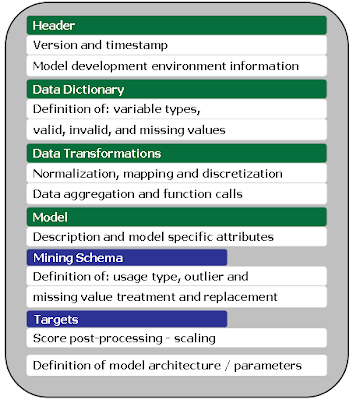
PMML Elements - A PMML file is highly structured. The list of PMML elements allows for data manipulation and model to be expressed in a single PMML file.

Header: contains general information about the PMML document, such as copyright information for the model, its description, and information about the application used to generate the model such as name and version. It also contains an attribute for a timestamp which can be used to specify the date of model creation.

Data Dictionary: contains definitions for all the possible fields used by the model. It is in the data dictionary that a field is defined as continuous, categorical, or ordinal (attribute optype). Depending on this definition, the appropriate value ranges are then defined as well as the data type (such as, string or double).

Data Transformations: transformations allow for the mapping of user data into a more desirable form to be used by the mining model. PMML defines several kinds of data transformations.
  • Normalization: map values to numbers, the input can be continuous or discrete.

  • Discretization: map continuous values to discrete values.

  • Value mapping: map discrete values to discrete values.

  • Functions: derive a value by applying a function to one or more parameters.

  • Aggregation: used to summarize or collect groups of values.
The ability to represent data transformations (as well as outlier and missing value treatment methods) in conjunction with the model itself is a major advantage of PMML. When it comes to the actual use of a PMML model, pre- and post-processing are embedded into the PMML file itself. All that is needed is the raw input data and users are on the go (see useful links for a primer on how to represent data pre-processing in PMML).

Data transformations and predictive models are represented in a single PMML file, which facilitates model deployment.

Model: contains the definition of the data mining model. A multi-layered feed-forward neural network is the most common neural network representation in contemporary applications, given the popularity and efficacy associated with its training algorithm known as Backpropagation. Such a network is represented in PMML by a "NeuralNetwork" element which contains attributes such as:
  • Model Name (attribute modelName)

  • Function Name (attribute functionName)

  • Algorithm Name (attribute algorithmName)

  • Activation Function (attribute activationFunction)

  • Number of Layers (attribute numberOfLayers)

This information is then followed by three kinds of neural layers which specify the architecture of the neural network model being represented in the PMML document. These attributes are NeuralInputs, NeuralLayer, and NeuralOutputs. Besides neural networks, PMML allows for the representation of many other data mining models including support vector machines, association rules, naive bayes classifier, clustering models, text models, decision trees, and different regression models.

Mining Schema: the mining schema lists all fields used in the model. This can be a subset of the fields as defined in the data dictionary. It contains specific information about each field, such as:
  • Name (attribute name): must refer to a field in the data dictionary.

  • Usage type (attribute usageType): defines the way a field is to be used in the model. Typical values are: active, predicted, and supplementary. Predicted fields are those whose values are predicted by the model.

  • Outlier Treatment (attribute outliers): defines the outlier treatment to be use. In PMML, outliers can be treated as missing values, as extreme values (based on the definition of high and low values for a particular field), or as is.

  • Missing Value Replacement Policy (attribute missingValueReplacement): if this attribute is specified then a missing value is automatically replaced by the given values.

  • Missing Value Treatment (attribute missingValueTreatment): indicates how the missing value replacement was derived (e.g. as value, mean or median).
Targets: The targets element allows for the scaling of predicted variables. It is a straight-forward way to represent post-processing of raw outputs.


Supported Modeling Techniques

The list of modeling techniques supported by the PMML standard is constantly being updated. Version 4.1 supports the following techniques:
  • Neural Networks (Feedforward neural networks as well as radial-basis)

  • Decision Trees (with coding for several missing value strategies)

  • Support Vector Machines

  • Linear and Logistic Regression Models (via a generic representation or a simplified one)

  • Association Rules

  • Clustering

  • Naive Bayes

  • Sequences

  • Text Models
  • Time Series
  • Rulesets
  • Scorecards
  • K-Nearest Neighbors
  • Baseline Models


PMML Example

The example below shows a PMML file used to represent a logistic regression model. In this model, the predicted variable is named honcomb. Note that this is a very simple model. There are only three input variables (female, read_score, and science_score) which are all double. There is no pre-processing of the raw input variables and so these are fed directly into the regression model which produces a value for honcomp (0 or 1).

PMML Example - File containing a simple regression model expressed in PMML.
A comprehensive list of PMML examples can be found at the Zementis website - Examples Page.

PMML Products

A range of products are being offered to produce and consume PMML. Please check the following page at the DMG website for an updated list of PMML-powered products:

http://www.dmg.org/products.html

Useful Pages

  • PMML Examples - A list of PMML 3.2 files including neural network models, support vector machines, decision trees, regression models and clustering.

  • ADAPA Predictive Analytics Engine - Available as a Service through the Amazon Elastic Compute Cloud, the ADAPA engine can import several PMML models. After uploading, models are available for scoring or verification.

Welcome to the World of Predictive Analytics!

© Predictive Analytics by Zementis, Inc. - All Rights Reserved.


Copyright © 2009 Zementis Incorporated. All rights reserved.

Privacy - Terms Of Use - Contact Us